Empowering Citizens to Monitor Australia's Waterways
Australia's rivers, lakes, estuaries, and coastal waters span vast and often remote regions, making frequent water quality monitoring both expensive and logistically challenging. CSIRO scientists require more ground-based observations to validate satellite data, monitor changes in water quality, and build long-term environmental datasets. At the same time, communities, schools, and citizen scientists are eager to contribute to protecting their local waterways.
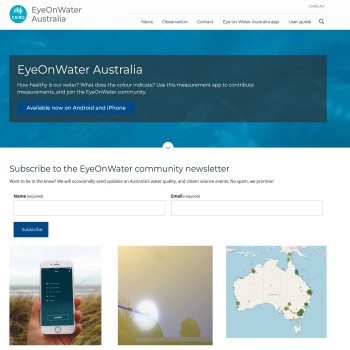
EyeOnWater Australia leverages the dedicated EyeOnWater Australia mobile app and the underlying EyeOnWater.org platform to support everyday citizens to be environmental observers.
Using their smartphone, volunteers visit a local water body and take a photograph of the water surface following simple guidance provided by the app. They then record observations including:
Water colour using the Forel-Ule colour scale
Location using phone GPS
Weather and cloud conditions
Optional measurements such as pH, salinity, conductivity and Secchi depth when additional equipment is used
Once submitted, every observation is automatically uploaded to the EyeOnWater.org platform where it is validated and stored. Via data access services the data is made available via CSIRO developed user interfaces and publications to researchers, educators and environmental managers: https://research.csiro.au/eyeonwater/. The platform creates a growing national database of observations contributed by communities across Australia.
How It Is Used
Local volunteers regularly monitor nearby rivers, lakes and beaches, creating continuous environmental records that would otherwise be impossible to collect through professional surveys alone.
Teachers incorporate the app into science and environmental education. Students learn about water quality while contributing real scientific observations, connecting classroom learning with hands-on fieldwork.
EyeOnWater observations complement satellite imagery used by Australia's AquaWatch initiative. Ground observations help calibrate and validate satellite measurements, improving the accuracy of national water quality monitoring and forecasting.
Scientists use the accumulated observations to study seasonal and long-term changes in water colour, algal activity, and aquatic ecosystem health. The data extends a scientific record based on the Forel-Ule colour scale that spans more than 200 years.
Results
By combining citizen science with cloud-based data collection, EyeOnWater Australia enables:
Increased geographic coverage of water quality observations
Faster collection of field data at low cost
Community engagement in environmental stewardship
Improved validation of satellite-derived water quality products
A continuously expanding national database supporting research and environmental management
Impact
EyeOnWater Australia demonstrates how a simple smartphone application can connect thousands of individual observations into a valuable scientific resource. Every uploaded observation strengthens Australia's understanding of its waterways while encouraging public participation in protecting one of the nation's most important natural resources.
The result is a collaborative monitoring network where citizens, schools, researchers, and environmental agencies work together through the EyeOnWater.org platform to improve the monitoring and management of Australia's freshwater and coastal ecosystems.
Join the Global EyeOnWater Community
Whether you are participating in Eyeonwater Australia or observing waters elsewhere in the world, EyeOnWater makes it possible for everyone to contribute to water science. Together, citizen scientists are creating one of the largest collections of water colour observations
This project was funded by a grant from the federal Department of Innovation, Industry and Science. The Eye on Water Australia project involves comparing water quality data from citizen scientists with satellite-derived ocean colour or coastal/inland water products.
The data from citizen scientists will be used to improve interpretation of satellite data. We can also compare citizen scientist data with temporal trends seen in satellite products.
Students are using the Eye on Water app to assess the water colour using the Forel-Ule scale. Students also use a chemical backpack to make physical and chemical measurements in their environments as part of a year 9 & 10 biodiversity and ecology unit.
The Australian version of the app is freely available and records the students' measurements in a national database. The chemical backpack water quality lab contains lessons, activities, and test kits to measure important water quality parameters relevant to the high school science curriculum.
The app can be downloaded via these links:
Dr Hendrik Jan van der Woerd visited Australia February 2018
The project was introduced to the Citizen Science community in Australia at the annual Australian Citizen Science Conference and CSIRO highlighted the new project that will have a unique Australian character. Dr van der Woerd (VU-IVM) visited CSIRO in Canberra to discuss the Eye on Water Australia project. Dr van der Woerd recently published his paper on water colour, 'Hue-Angle Product for Low to Medium Spatial Resolution Optical Satellite Sensors' and has been collaborating with the Eye on Water Australia's scientific team. They aim to implement the Hue-angle method to Australian data in order to stimulate integration of citizen data and satellite observations of inland and coastal waters.


 The project was introduced to the Citizen Science community in Australia at the annual Australian Citizen Science Conference and CSIRO highlighted the new project that will have a unique Australian character. Dr van der Woerd (VU-IVM) visited CSIRO in Canberra to discuss the Eye on Water Australia project. Dr van der Woerd recently published his paper on water colour, 'Hue-Angle Product for Low to Medium Spatial Resolution Optical Satellite Sensors' and has been collaborating with the Eye on Water Australia's scientific team. They aim to implement the Hue-angle method to Australian data in order to stimulate integration of citizen data and satellite observations of inland and coastal waters.